For a long time, the world of orthodontic treatment was a one-track process. If teeth needed straightening, overcrowding needed fixing or someone’s bite needed correcting, it was metal braces, or nothing.
Until an American student had a neat idea. And along with his entrepreneurial classmates, he decided to make that neat idea a reality. The first clear aligners were born, and their inventors named them Invisalign. Within a few years, they’d revolutionised orthodontic treatment.
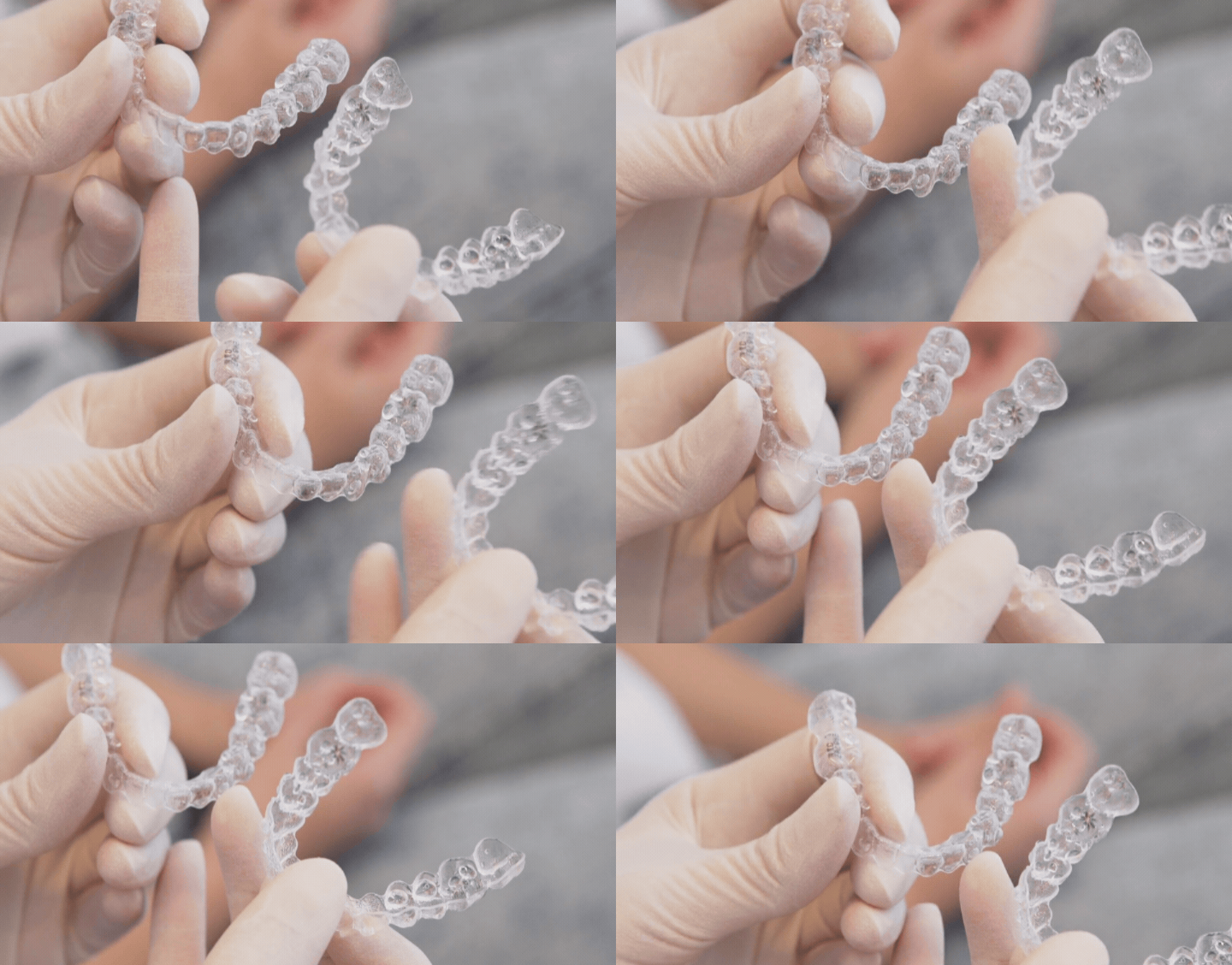
Their invention gave practitioners and patients a faster, more comfortable and more affordable way to achieve straighter teeth.
Today, Invisalign is the most prominent name in the world of invisible braces. And there are good reasons for this—reasons we’ll get to. But the name has also caused some confusion amongst patients searching for clear aligner treatment. The result is an unnecessary head-to-head: clear aligners vs Invisalign.
In this article, we’ll clear up why it may not be helpful to compare Invisalign to clear aligners. And reveal the essential question to ask as you work out the next step in your clear aligner journey.
Invisalign. It’s a brand, not a treatment
Invisalign was one of (if not the) first invisible brace companies in the world. It’s been around for decades and as the market has grown, so has its name. For some patients, ‘Invisalign’ has become the orthodontic equivalent of ‘Hoover’ or ‘Velcro’.
For some of us, all vacuum cleaners are Hoovers, and all hook or loop fasteners are Velcro. Rightly or wrongly, people use the brand interchangeably to describe the thing they mean. The same has happened with clear aligners and Invisalign.
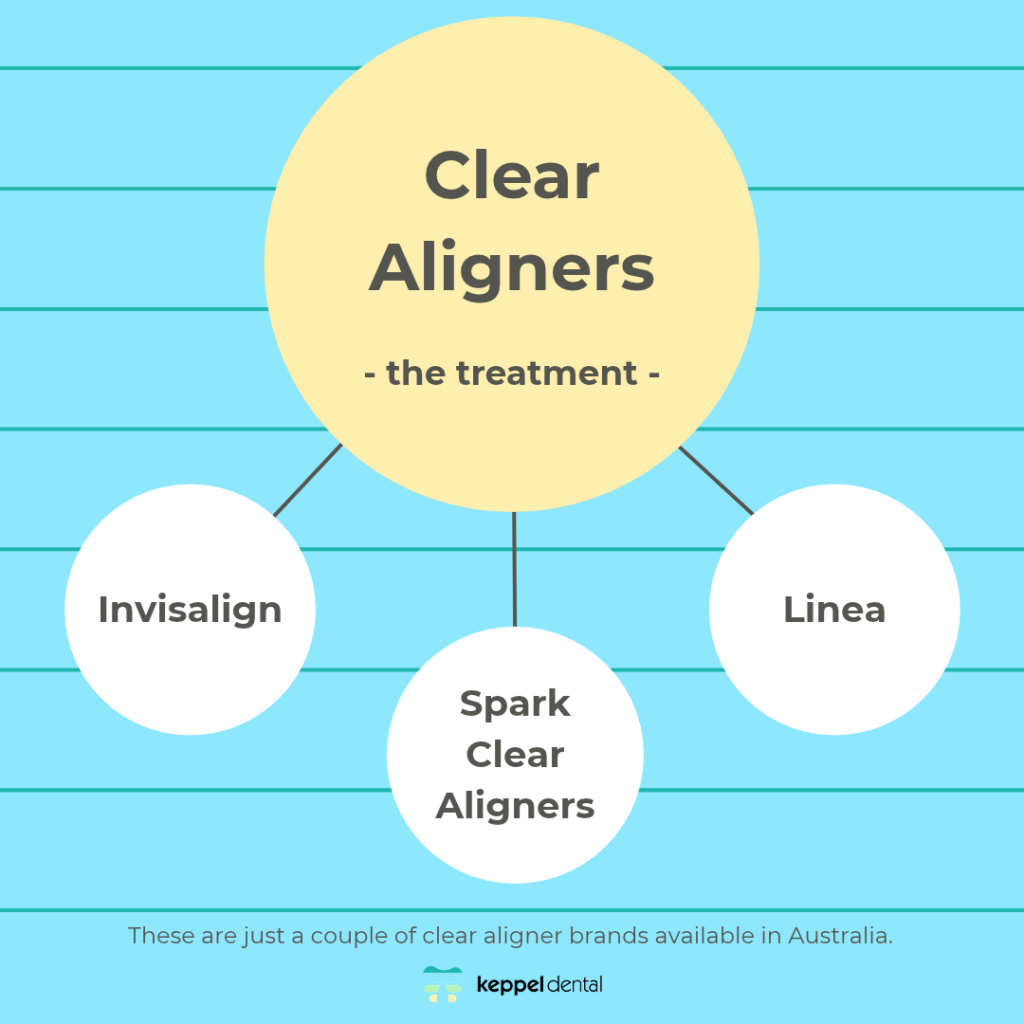
Clear aligner treatment is one way to straighten teeth. Invisalign is just one brand making invisible braces for use during clear aligner treatment.
The clear aligner method
Whether you straighten your teeth using Invisalign or another clear aligner brand, the method is similar: a series of thin, custom-made plastic trays (aligners) are worn over the top and bottom teeth. By wearing each aligner in a specific order for 1-2 weeks, the gentle ongoing pressure applied to the teeth by the tray moves them into the desired position.
Each clear aligner brand works to help patients get the straight teeth they want. That’s the main goal. But it isn’t the only similarity between clear aligner brands.
The benefits patients love
Invisible braces come with some appealing benefits, which is why millions of people each year choose clear aligners as their preferred treatment for orthodontic corrections.
Discreet design
Clear aligners are a subtle treatment option for those who don’t want the world and its mum to know they’re wearing braces. The clear plastic is deliberately designed to be barely noticeable, which patients young and old seem to appreciate.
Greater flexibility
Unlike metal braces, clear aligners are removable, offering freedom and flexibility. When it comes to eating and drinking nothing is off the menu (as long as you remove the tray beforehand), or if you need to take the braces out for specific events—playing sports, having formal photos, or giving a speech.
Of course, the flipside to this flexibility is the need for great self-discipline. For clear aligner treatment to work, you need to wear the trays for at least 20 hours each day.

Hygiene and upkeep
Daily health routines don’t change. The tray is removed before cleaning, you can brush and floss your natural teeth as usual, with your regular toothpaste and brush.
Cleaning clear aligners
Worried about the upkeep of clear aligners?
Cleaning the trays to make sure they stay clear and safe to wear only takes 4 simple steps.
Why is Invisalign so well known?
If all clear aligners provide
- discreet orthodontic treatment
- greater flexibility so you can still eat and drink whatever you want
- zero disruption to your daily oral health routine
Why is Invisalign the first name that springs to mind?
A look at the company’s history and its significant role in the clear aligner market will answer that question.
Invisalign is the brainchild of investor and business executive Zia Chishti. He had the idea in 1997, when he was still a student at Stanford University and, conveniently, was receiving orthodontic treatment. The traditional way. Using metal braces.
The story goes that as Zia was handed a plastic retainer toward the end of his treatment to keep his newly straightened teeth in line, he wondered if the same material could be used to move the teeth and complete an entire realignment treatment.
So he floated the idea to some of his student mates; they decided to put their heads together and work on a prototype to create the first clear aligner tray. Within a few years, they’d created an FDA-approved product that was piquing the interest of patients.
A way to straighten teeth without the use of train tracks? Yes please, said the US-public.
Invisalign transformed the face of orthodontic treatment. When it rolled out to the mass market in 1999, there wasn’t another product like it. But many practising orthodontists were sceptical and hesitant to adopt this new technology. There simply wasn’t enough evidence of its effectiveness.
But those pioneers who did get on board weren’t disappointed. Nor were their patients, so initial fears soon fizzled out.
During the brand’s first few years of business in the early 00s, Invisalign:
- ran huge marketing campaigns in the US
- won several industry innovation awards
- expanded overseas
- introduced strict training standards for Invisalign dentists
- was recognised as significant enough to be included in the syllabus and training in dental medical programs.
Because it was the first and, for a while, the only clear aligner brand, Invisalign’s name is still synonymous with the entire clear aligner treatment. Invisalign’s over 20 years of experience gives the brand an edge their competitors don’t have.
Those two decades of work allowed them to:
- refine their product and process
- become a household name in more than 90 countries
- help correct the smiles of more than 18 million people.
Eventually, other rival brands appeared on the market, growing the sector into the multi-billion-dollar industry it is today. But when it comes to separating different clear aligner brands in terms of technology and material, there’s not much between them.
Invisalign vs clear aligners: The major differences
Age, motivation, budget and treatment expectations—each of these factors may influence why someone chooses one clear aligner brand over another. And it’s only by drilling down into the specific reasons for orthodontic treatment that the subtle differences between clear aligner brands become, well, clear.

Ongoing monitoring and support, and remote treatment paths
Weighing up differences between specific brands is an important part of getting the right clear aligner care. But we’d argue that there’s an even more important decision you need to take.
Great clear aligner care starts by picking a treatment path. And in Australia, there are two care models to choose from.
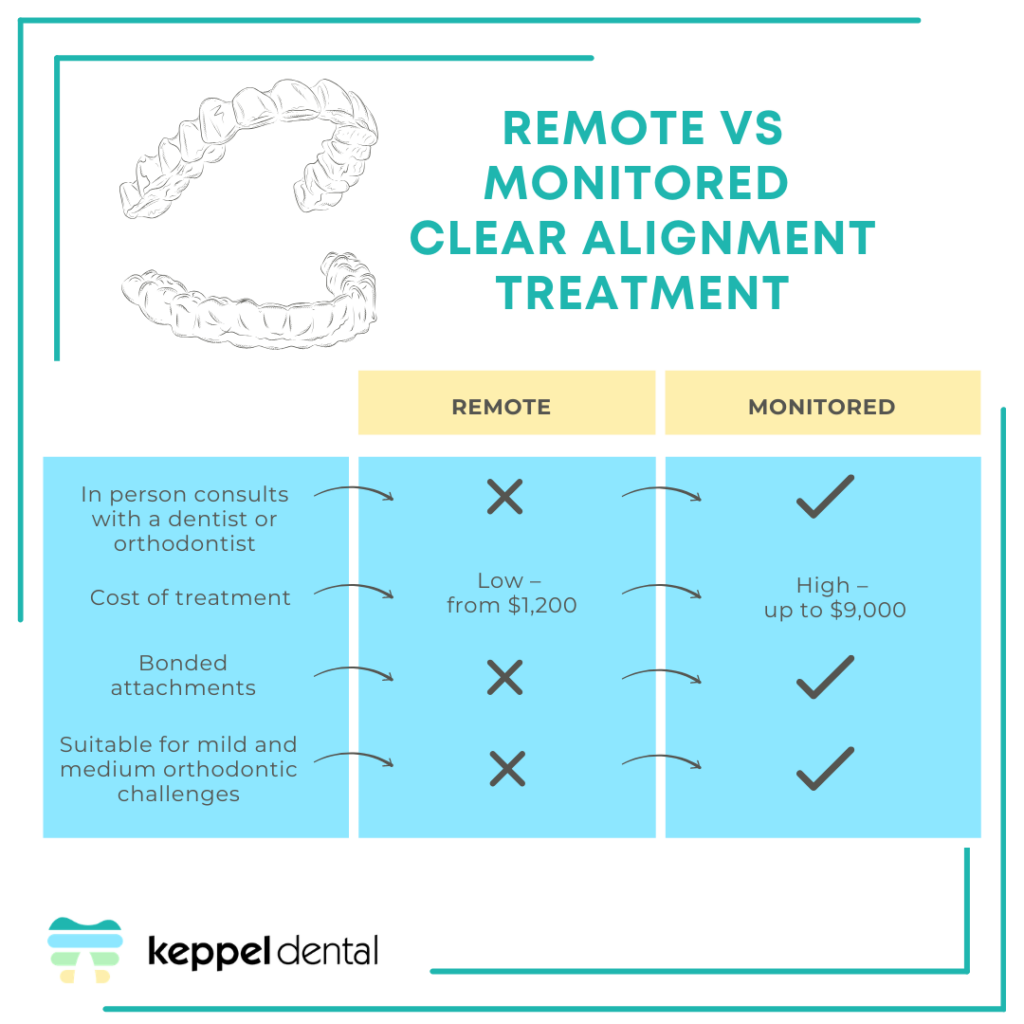
Treatment path 1: Consistent monitoring and support. The patient works with a dentist or orthodontist and is under their care and supervision throughout the treatment. Appointments are scheduled every couple of weeks for check ups and treatment monitoring.
Treatment path 2: Remote assessment and care. Treatment is carried out digitally, so the patient is unlikely to see a dentist. To get the trays, the patient is responsible for taking photos or impressions of their mouth and organising oral scans or x-rays, which they forward to the clear aligner company. The material is reviewed by a dentist, a care plan is created, and the trays are mailed out to the patient. Any check ups and treatment monitoring are done via video call or by sending more images/scans.
A patient who wanted to use Invisalign would follow treatment path 1.
Looking at the Invisalign vs clear aligner question from this perspective changes things. The comparison isn’t about the brands. It’s about which treatment path will achieve the results you want, and the experience and support needed to get you there.
Price differences
Approximately 18% of Australian adults say that the cost of a recommended treatment influences or prevents their decision to go ahead. The cosmetic dentistry industry knows that budget barriers exist. Its response has been to tweak the treatment method—referred to earlier as the treatment paths—so there are clear aligners to suit both higher and lower budgets.
The cost of clear aligner treatment in Australia can be as low as $1,200 or as high as $9,000. Brand name does influence price. (And you can expect Invisalign to sit towards the top end of that price bracket.) But it’s not the only factor.
Clear aligner brands that follow treatment path 1 (consistent monitoring and support) generally cost more than treatment path 2 (remote clear aligner treatments). Regular product training, practice overheads and the dentist’s time and experience all contribute to the final treatment cost.
Effectiveness and case complexity
Patient commitment is at the heart of successful clear aligner treatment. The journey may take up to two years, and trays should be worn for at least 22 hours each day. It’s a lot. But to help ensure their effectiveness, aligner attachments can be bonded to the teeth.
These small, natural-coloured bonds anchor the aligner, keeping it in place so it continually applies the pressure needed to move the teeth. Attachments are a great way to supercharge the alignment process, but not every patient will have them.
Attachments can only be bonded to the teeth by a dentist. Patients receiving consistent monitoring and support are highly likely to have this. Patients using remote clear aligner treatments probably won’t. (Although there’s a caveat around that ‘probably won’t’ and we’ll get to it in a moment.)
So if the remote clear aligners may not be as effective, why do people still use them?
Well, they’re good for correcting mild orthodontic challenges. These may include:
- small tooth gaps
- crowding and overlapping.
Bonded attachments aren’t always essential, as the pressure of the tray alone might be enough to move the teeth small distances.
However, if the tooth gaps are larger (but still less than 6mm), there’s overbite, underbite, crossbite or openbite, the teamwork of aligners and bonded attachments will be more effective.
Clear aligner brands in Australia
Invisalign is provided by dental practices across Australia. But as we know, it’s not the only brand.
Here are some others, divided into groups based on whether they’re remote or monitored.
Remote clear aligner brands
- Smilepath
- NewSmile
- Smileie
- SmartSmile
Monitored clear aligner brands
- Invisalign
- Spark Clear Aligners
- ClearCorrect
Hybrid treatments
Combining remote and monitored care, the hybrid clear aligner model involves patients sending in images of their teeth, then being referred to a registered dentist associated with that brand. The dentist completes scans and x-rays used to create the treatment plan. Once the plan has been outlined, the patient returns to the dentist for the bonded attachments, but then the rest of the treatment is completed remotely.
- Bitesoft
- Linea
Why we choose to use Spark Clear Aligners
There are lots of clear aligner options in Australia. But at Keppel Dental, we’ve chosen to treat our patients using Spark Clear Aligners. There are three key reasons for this.
- They’re easy to use. Creating treatment plans is simple and the information is easy to understand. It also gives a crystal-clear overview of the expected outcomes.
- The tray material is high quality. Most clear aligners are made of high-quality materials, but we’ve found that Spark’s TruGen™ material is the easiest to work with, and our patient feedback confirms that it’s comfortable to wear.
- They look the best. The clear aligners have a barely-there look for maximum discretion.
Choosing the best clear aligner treatment for you
Clear aligner treatment is a commitment. Patients who wear the aligners for at least 22 hours a day, for the entire length of the treatment, are more likely to get the outcomes they desire.
While it is useful to compare Invisalign to other clear aligner brands, this is just one consideration. Discussing and deciding which clear aligner treatment path will suit you best—remote clear aligner treatment or supported and monitored treatment—is a vital step in the process.
Delivering clear alignment treatment and care in Central Queensland
Whether you’re at the start of your clear alignment journey or ready to take the next step, Keppel Dental can help. We use the latest digital dentistry techniques, clear aligner technology, and high-quality aligner products to deliver the best orthodontic care possible for patients in Central Queensland and beyond.
Find out more about our clear aligner treatment and how we make it work for you.
Learn About Clear Aligners


